Blog
How to build a company brain, part 8: research that can still be trusted a year later
- Company brain
- Research
- AI agents
When research done by an AI agent goes wrong, it goes wrong quietly. The answer reads as confident, the sources are vague, and six months later nobody can say which parts were checked. So in a brain, research follows one template and a short list of practices. The aim is that someone can check a finding a year from now, even if the web page behind it has changed.
Key takeaways
- Check what the brain already knows before you research. Extend the old note, don't redo it.
- Every source gets two dates, the page's own and the day it was read, plus a saved snapshot.
- Every finding has a footnote and a label: measured (seen, counted) or inferred (our reading).
- Start each note from a decision, and stop when that decision has what it needs.
- File results where the next person will look: the feature brief, the competitor pages, knowledge.
The research note template
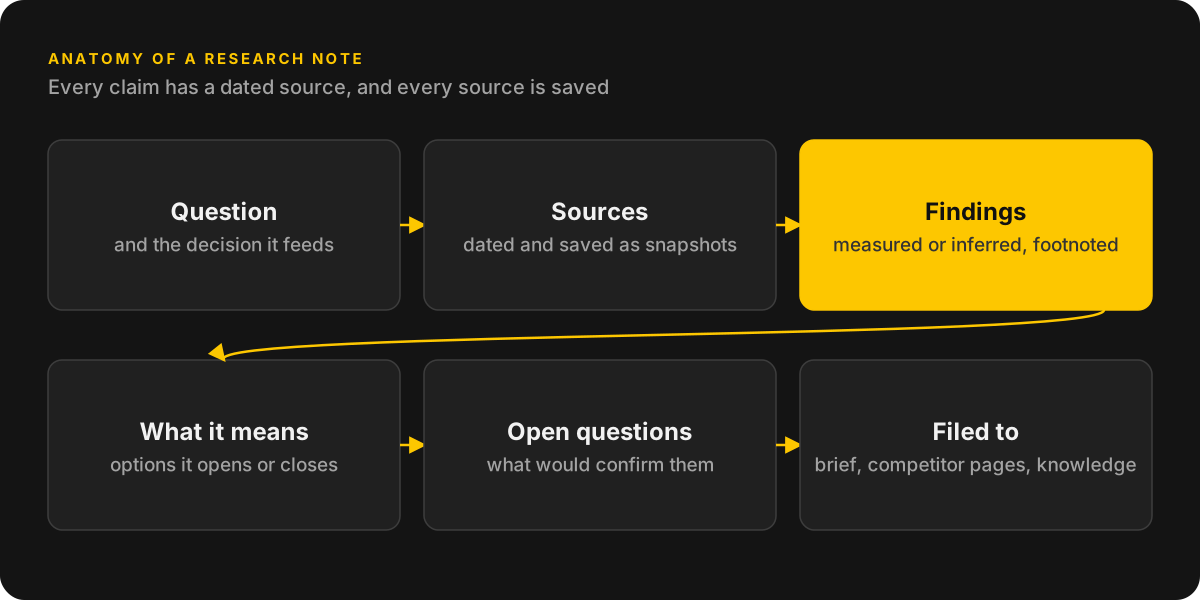
Every research note in the Termino brain has six parts, in this order.
- The question, and which decision or version it feeds.
- The sources, one row each, with the page's own date (published or updated, or "undated") and the date it was read.
- The findings. Short, one footnote per claim, each labelled measured or inferred.
- What it means for the product.
- Open questions, and what would answer them.
- Filed to: the pages that were updated because of this note.
The practices
The template says what a note contains. These six habits are how the agent fills it in.
- Search the brain first. Before any web search the agent checks what's already there: earlier research, competitor pages, the learnings log, older snapshots.
- Save every source. A copy of each page's text goes into sources/web/, sorted by year and month. Where the layout matters, a pricing table for instance, add a screenshot. That needs an agent with a browser tool, or you take it yourself. Pages change. A saved copy doesn't.
- Footnote every claim. Each finding cites its source by id, so a reader can go straight to the evidence.
- Keep measured and inferred apart. "Their pricing page lists three plans" is measured. "They are moving upmarket" is inferred. Mix the two and a guess starts to read like a fact.
- Label agency and vendor numbers. A price range from a vendor's blog is the vendor's claim, and the note says so.
- File where people look. The key finding goes into the feature brief. Competitor changes go onto the competitor page, newest snapshot first.
Research for a decision, not for reading
Each note starts from a decision. Should the waitlist be part of the free plan? Which onboarding step loses people? A note with no decision behind it has no natural end, so it keeps growing. A note with one stops when the decision has what it needs, and the decision log links back to it.
About the prompt below: name the competitors yourself. If you ask an agent for "the three biggest" apps, it has to guess what biggest means, and that guess is an inferred claim sitting in your very first line.
Goal: answer this research question for the decision "is the waitlist part of the free plan?": how do <app 1>, <app 2> and <app 3> handle waitlists for cancelled appointments?

Inputs: our brain (existing research, competitor pages, the learnings log, older snapshots) and the public websites of the three apps.

Do this:
1. Search our brain first and tell me what we already know.
2. Collect sources. For each page note its own date (or "undated") and today's date, and save a copy of its text in sources/web/YYYY/MM/.
3. Write the note from templates/research.md. If that file does not exist, create it first with six parts: question, sources, findings, what it means, open questions, filed to.
4. Add the key finding to work/waitlist/brief.md and update the competitor pages.

Constraints: one footnote per claim. Label each finding Measured or Inferred. Numbers from a vendor's own page are labelled as the vendor's claim. Do not state anything you have no saved source for. If you could not open a page, list it under open questions.

Definition of done: the note is filed, every footnote points to a saved copy, and you list the pages you changed.Frequently asked questions
How do I make AI research trustworthy?
Give every claim a dated source and save a copy of every page. Label each finding as measured or inferred. Then file the result where the next person will look for it.
Why save snapshots of web pages?
Pages get edited or disappear. A dated copy lets anyone check later what the page said on the day the decision was made.
What is the difference between measured and inferred?
Measured means seen or counted, such as a price on a page. Inferred is our reading of it, such as a guess about a competitor's strategy. A note keeps the two apart.
Talk to me
Building an AI product and need someone senior to own the technical side? Book a free 30-minute call.