Blog
How to build a company brain, part 2: the benefits, from consistency to knowledge that stays
- Company brain
- Knowledge management
- Founders
In a small company, a lot of what matters lives in one person's head. When that person leaves, the reasons behind decisions go with them, along with the client history and the research they never finished. Whoever takes over starts from guesses.
A company brain is how I deal with that. It also gives you a few things you only notice once you have one. I'll go through them using Kranich Studio, the made-up company from part 1.
Key takeaways
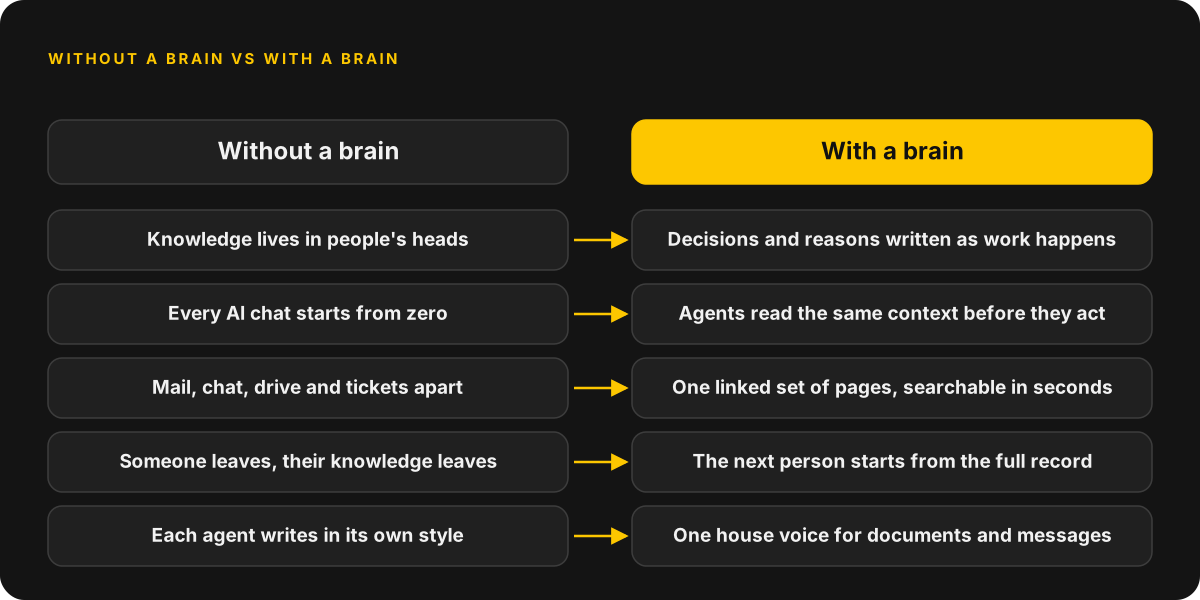
- Knowledge stays when people leave, because it's written down while the work happens and not in a rushed handover.
- Agents that read the same pages before acting are far less likely to contradict each other.
- Templates and a short list of writing rules give documents, and the messages agents draft, one house voice.
- Mail, chat, drive and tickets become one linked record that a single search covers.
- The software costs little. What you pay in is discipline: someone writes the rules and someone reads the summaries.
Knowledge that stays when people leave
At Kranich Studio every decision gets a row in the log with its reason. Every client has a status page. Every piece of research keeps its sources. Nobody wrote any of this for a handover. It was written while the work happened, because the routines ask for it.
So when a project lead leaves, the next person opens the client page and can read the whole history in an afternoon. The agent working with them reads it in seconds.
Agents that agree with each other
This is the benefit I think people underestimate. Picture two agents working on Termino, one on the pricing page and one on the onboarding emails. Both read the same pricing rules and the same decision log before they write anything. They can still make mistakes. What they can't do any more is contradict each other just because each was briefed differently.
It works the same way for people. A salesperson and the product lead read one knowledge page about what the product does today. If a sales promise drifts away from the roadmap, there's a page to check it against, and someone notices.
One house voice, including AI-written messages
There's a template for each kind of document: brief, research note, spec, decision, meeting note, digest. A short list of writing rules sits next to them. A spec one agent wrote on Monday looks like the spec another agent wrote on Friday.
The same rules cover messages. Kranich's support intake drafts a reply to each customer mail and posts the draft, with what it found, in the team's support channel for a person to check and send. Digests, summaries and reply drafts come out in the same voice. I think that's most of what makes AI-written messages acceptable to a team and to customers. They sound like the company every day, whichever model wrote them.
One record instead of five places
Mail, meeting notes, chats, tickets and documents used to be five places to look. In a brain they're one set of linked pages. You search once, and the links show where a fact came from.
It also cuts what you spend on AI. An agent that can read a two-page summary doesn't need forty raw emails pasted into its context, and what an agent reads is what you pay for, in tokens or in usage limits.
What it costs
The software costs little: Markdown files, a private Git repository, an agent you probably already pay for, and later a small SQLite index, which is a single file with no server to run.
The cost is discipline. Someone has to write the rules, and someone has to read the summaries and approve things. If nobody does, you have a folder of confident notes that no one checked. Part 6 and part 7 are about keeping that work light.
Frequently asked questions
What happens to company knowledge when an employee leaves?
Whatever was written down stays. In a brain, decisions, client history and research are recorded with their reasons and sources while the work happens, so the next person and every agent start from the same record. What was never written down still leaves.
Does a brain make AI agents more reliable?
More consistent, at least. Agents that read the same rules and facts before acting tend to agree with each other, and they guess less about the parts you forgot to mention. They can still be wrong, which is why a person approves.
Is it worth it for a company of five people?
I think so, and it's easier to start small. One entry page, one client folder and a daily routine already remove a lot of the re-explaining.
Sources
- About SQLite (single file, no server) sqlite.org
Talk to me
Building an AI product and need someone senior to own the technical side? Book a free 30-minute call.